

 Deutsch
 English
 français
 español
 العربية
 中文

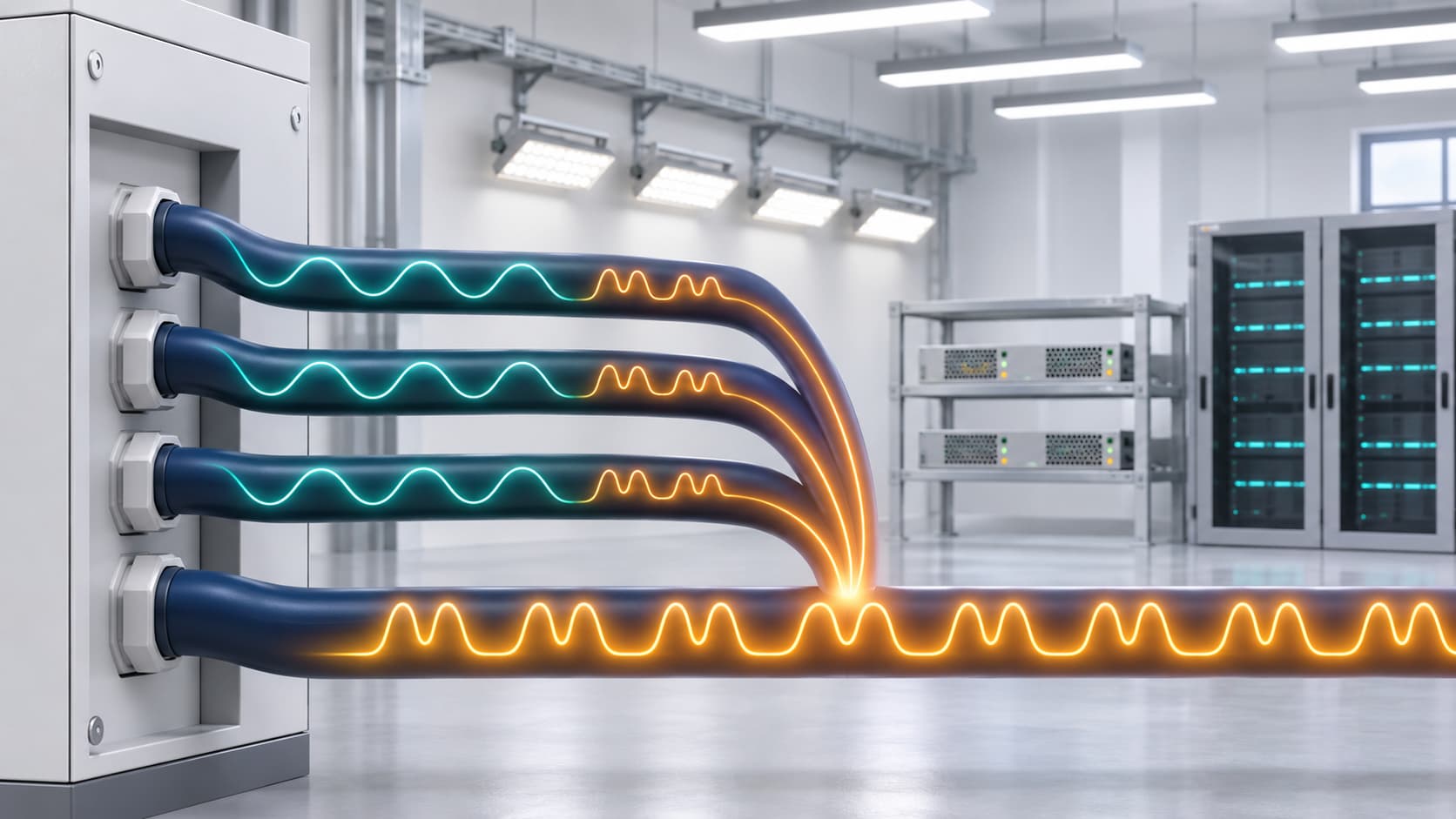
In a balanced three-phase, four-wire system, neutral current should be low with linear loads. That expectation can fail in facilities filled with LED drivers, computers, servers, UPS equipment, and other electronic power supplies.
These nonlinear loads can produce third-harmonic current and its multiples. The harmonic components add in the neutral instead of cancelling, sometimes making neutral current equal to or higher than an individual phase current.
High neutral current is therefore not always evidence of poor load balancing. Correct diagnosis requires both RMS current measurements and a harmonic spectrum.
Balanced fundamental currents are separated by 120 electrical degrees, so their sum at the neutral is close to zero. Evenly distributed linear single-phase loads therefore produce little fundamental neutral current.
When phase loads are unequal, the difference flows in the neutral. Redistributing single-phase loads can reduce this component.
Harmonics change the situation because not every frequency component retains the same cancellation relationship.
The third harmonic is three times the fundamental frequency: 150 Hz on a 50 Hz system or 180 Hz on a 60 Hz system. The ninth, fifteenth, and other odd multiples of three are called triplen harmonics.
In a three-phase, four-wire system, the third-harmonic components from each phase are in phase with one another at the neutral. Instead of cancelling, they add arithmetically.
If each phase contributes 10 A of third harmonic, the neutral may carry approximately 30 A of that harmonic even with balanced fundamental loads. Total RMS neutral current also includes other components.
Triplen harmonics commonly come from single-phase nonlinear loads whose electronic inputs draw pulsed current.
Common examples include:
Older or lower-quality switched-mode power supplies
Desktop computers and office equipment
Servers and telecommunications equipment
LED lighting drivers
Single-phase UPS systems
Battery chargers and electronic control equipment
Modern power-factor-corrected equipment may produce less distortion, so equipment type alone does not prove a problem.
| What you observe | Possible explanation | What to check first |
|---|---|---|
| Neutral current falls after phases are rebalanced | Fundamental load unbalance | RMS current and kW on each phase |
| Neutral stays high with balanced phase currents | Third and other triplen harmonics | Neutral and phase harmonic spectra |
| Neutral THDi is extremely high but RMS current is low | Small neutral fundamental used as the percentage reference | Harmonic current in amperes, not THDi alone |
| Neutral or termination is hotter than phase conductors | Excess current, loose connection, or undersized path | Thermal scan, torque, conductor and protection ratings |
| Neutral-to-ground voltage rises with electronic load | Neutral impedance and harmonic current | Neutral current, connections, and voltage drop |
| One panel is affected more than the main incomer | Harmonic loads are concentrated locally | Measurements at branch, panel, and transformer levels |
The measurement location matters. Harmonic currents may be severe in one distribution panel but appear lower upstream when mixed with other loads.
A true-RMS clamp meter can reveal total current, but it cannot separate fundamental unbalance from triplen harmonics. Use a power-quality analyser capable of measuring the neutral waveform and individual harmonic orders.
THDi is expressed relative to fundamental current. Because the neutral fundamental may be small, moderate harmonic current divided by that value can produce THDi above 100%.
This is not necessarily an error and does not describe loading by itself. Examine total RMS amperes and individual harmonic amperes against equipment ratings.
A neutral designed around cancellation may overheat when triplen harmonics accumulate. Loose connections add resistance and create concentrated hot spots.
Harmonics add winding and eddy-current losses and may circulate in certain transformer connections. Oversizing the downstream neutral does not remove transformer loading.
Current through neutral impedance creates voltage drop, increasing neutral-to-ground voltage and potentially affecting phase-to-neutral loads.
Nonlinear loads can invalidate designs based on strong neutral cancellation. Sizing and protection must follow applicable codes, equipment instructions, and site-specific assessment.
Measure phase and neutral RMS current simultaneously and record the operating state because electronic loads vary throughout the day.
Capture phase and neutral spectra, focusing on the third, ninth, and fifteenth orders. Compare harmonic amperes rather than percentages alone.
Check load distribution, neutral continuity, conductor size, terminations, protection, and transformer loading. Thermal surveys should complement electrical measurements.
Only qualified personnel should inspect or modify energised distribution equipment.
The appropriate solution depends on whether the main cause is load unbalance, triplen harmonics, or both.
Possible measures include:
Redistributing single-phase loads to reduce fundamental unbalance
Specifying electronic equipment with low input-current distortion
Correctly sizing the neutral conductor and its protection
Separating large nonlinear load groups where appropriate
Using harmonic-mitigating transformer arrangements after an engineering study
Applying a neutral blocking filter where technically suitable
Installing a four-wire active harmonic filter designed to compensate neutral harmonics
An oversized neutral carries more current but does not remove harmonics. A K-rated transformer tolerates harmonic heating; it does not automatically cancel harmonic current.
An active harmonic filter must be selected for the conductor arrangement and harmonic orders involved. A three-wire filter intended mainly for fifth and seventh harmonics may not address third-harmonic current in a four-wire neutral.
Yes. Third-harmonic currents from the three phases add in the neutral, so the neutral RMS current can approach or exceed an individual phase current in a harmonic-rich four-wire system.
It reduces neutral current caused by fundamental load unbalance. It does not cancel third and other triplen harmonics because those components are in phase in the neutral.
It can provide additional current-carrying capacity when properly engineered, but it does not reduce harmonic current or protect upstream equipment from harmonic losses.
Yes, if it is a four-wire model designed and rated for neutral harmonic compensation. Selection should be based on measured harmonic current and load variation.
Neutral current may remain high even when phase loads appear balanced because third and other triplen harmonics add instead of cancelling. Electronic phase-to-neutral loads are common sources, but RMS readings and a harmonic spectrum are needed to confirm the cause.
Measure phase and neutral current together, evaluate harmonic amperes, and check the complete neutral path before selecting a solution. Load balancing, conductor sizing, low-distortion equipment, transformer arrangements, and active filtering solve different parts of the problem.
YT Electric can review your phase and neutral measurements, harmonic spectrum, transformer loading, and distribution arrangement to help identify the cause and recommend an appropriate mitigation strategy.



 IPv6-Netzwerk unterstützt