

 Deutsch
 English
 français
 español
 العربية
 中文
中文
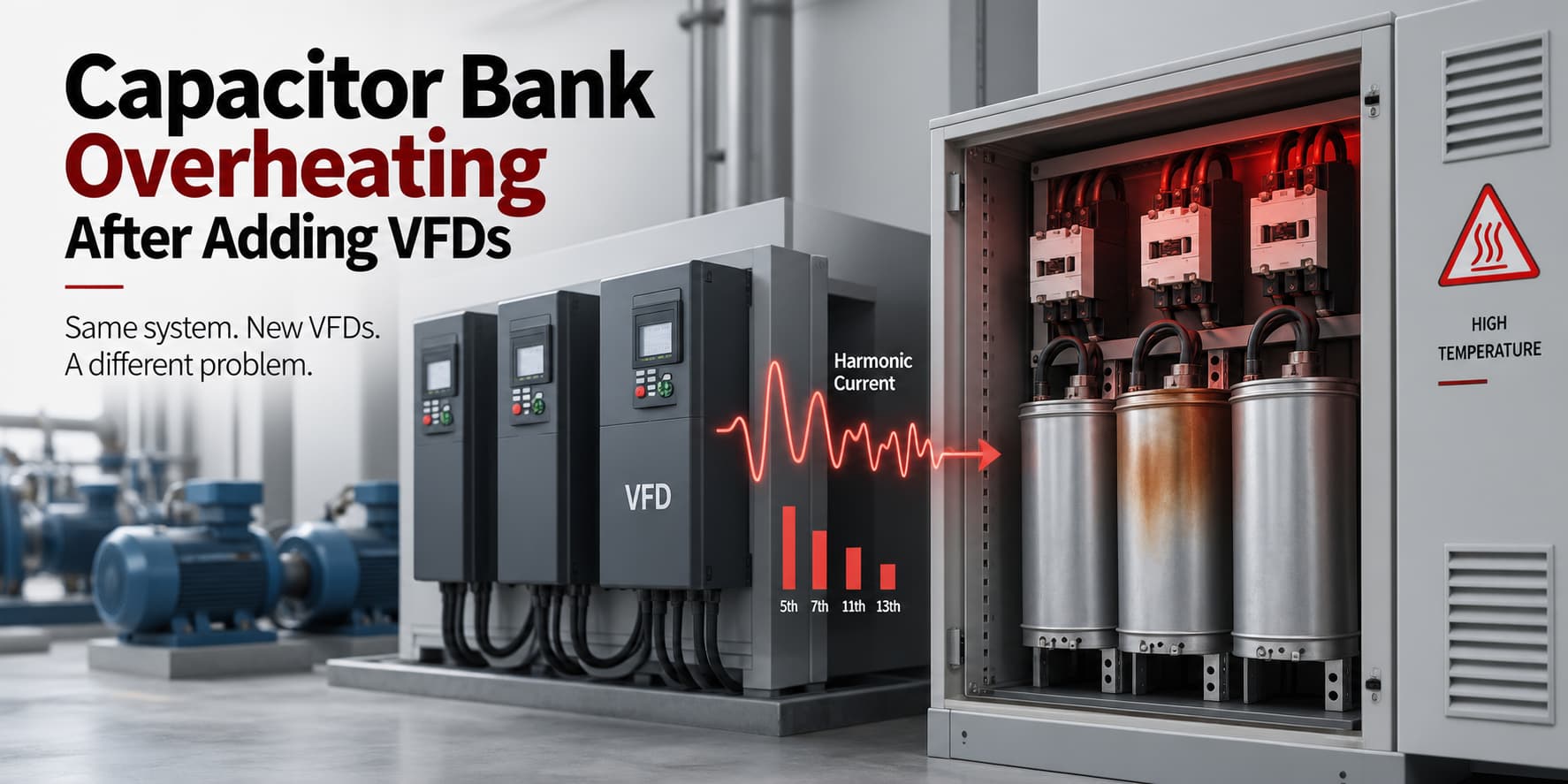
Capacitor bank overheating is a common problem in factories that add more variable frequency drives. The capacitor bank may have worked well for years, but after new VFDs are installed, the cabinet temperature rises, fuses fail, contactors burn, or capacitors become swollen.
This does not always mean the capacitor bank was poorly made. In many cases, the electrical environment has changed.
VFDs improve motor control and energy efficiency, but they also create harmonic distortion. When harmonic current flows through the power system, it can place extra stress on capacitor banks. If the condition is not checked, capacitor bank overheating can lead to repeated failure and unstable power factor correction.
A capacitor bank is designed for power factor correction. It supplies reactive power to improve power factor and reduce unnecessary current in the system.
It is not designed to remove harmonics.
When the electrical system has mostly stable motors and linear loads, a capacitor bank can work normally. But when the site adds more VFDs, rectifiers, UPS systems, welders, or other electronic loads, the waveform becomes more distorted.
This can increase the stress on the capacitor bank.
Common causes of capacitor bank overheating include:
Harmonic distortion
Harmonic resonance
Overvoltage
Overcurrent
Poor ventilation
Failed contactors
Weak capacitor design
Incorrect detuned reactor selection
Load changes after system expansion
In VFD-heavy systems, harmonics and resonance are often the most important causes.
A variable frequency drive controls motor speed by converting AC power into DC power, then converting it back into controlled AC output for the motor.
This process helps control pumps, fans, compressors, conveyors, and production machines. But the input side of the VFD does not draw current in a smooth sine wave. It draws current in pulses.
These current pulses create harmonic distortion.
The most common harmonic orders from standard VFD systems are usually the 5th, 7th, 11th, and 13th harmonics. These harmonics flow through the electrical system and increase heat in transformers, cables, switchgear, and capacitor banks.
When a plant has only one small VFD, the harmonic problem may be limited. When many VFDs operate on the same low voltage distribution system, harmonic current can become much stronger.
That is when capacitor bank overheating often begins.
Capacitors have low impedance at higher frequencies. This means harmonic current can flow into the capacitor bank more easily than expected.
The capacitor bank may then carry current higher than its normal design condition. This creates extra heat inside the capacitor elements, contactors, fuses, cables, and cabinet.
Over time, this heat reduces service life.
The problem can become worse if the capacitor bank was selected only for power factor correction without checking harmonic distortion. In that case, the kvar rating may be correct, but the system may still be unsafe for standard capacitors.
This is why capacitor bank overheating should be treated as a power quality issue, not only a capacitor issue.
Harmonic resonance is one of the most serious risks in a system with capacitor banks and VFDs.
Resonance can happen when the capacitor bank interacts with the transformer and system impedance. Instead of reducing system stress, the capacitor bank may amplify certain harmonic frequencies.
When this happens, current and voltage distortion can increase quickly.
Harmonic resonance can cause:
Severe capacitor bank overheating
Repeated fuse failure
Burnt contactors
High capacitor current
Cabinet temperature rise
Breaker trips
Voltage distortion
Short capacitor life
This is why a capacitor bank may fail even if the power factor correction capacity looks correct on paper.
The issue is not only kvar. The issue is the harmonic condition of the system.
Capacitor bank overheating usually shows warning signs before complete failure.
Common signs include:
Hot capacitor cabinet
Swollen capacitor cans
Burnt contactors
Repeated fuse blowing
Breaker nuisance tripping
Unstable power factor readings
Strong cabinet smell
Discolored cables or terminals
Increased transformer noise
Higher maintenance frequency
These signs should not be ignored.
If the same parts keep failing after replacement, the root cause is probably not the parts alone. The site should check harmonic distortion, resonance risk, and load changes caused by VFDs.
Many facilities respond to capacitor bank overheating by replacing capacitors, fuses, or contactors.
This may restore operation for a short time. But if harmonic distortion remains high, the same problem can return.
Replacing parts does not remove harmonic current.
A better review should check:
THDi
THDv
Harmonic current
Dominant harmonic orders
Transformer capacity
Capacitor bank kvar
Detuned reactor rating
VFD quantity
VFD power rating
Load variation
Cabinet temperature
Ventilation condition
This helps identify whether the overheating comes from poor ventilation, old components, overload, harmonic distortion, or harmonic resonance.
A standard capacitor bank is more exposed to harmonic stress. In systems with VFDs, a detuned capacitor bank is often safer.
A detuned capacitor bank uses reactors with capacitors. The reactor helps shift the resonance frequency and reduce the risk of harmonic amplification.
Common detuning options include 5.67%, 7%, and 12.5%, depending on the system condition and dominant harmonic orders.
However, a detuned capacitor bank is still mainly for power factor correction. It does not actively remove harmonic current from the system.
If the harmonic distortion is high, the site may need an Active Harmonic Filter instead of relying only on detuned capacitors.
An Active Harmonic Filter is used when harmonic distortion is the main problem.
It measures harmonic current in real time and injects compensation current to reduce distortion. This helps improve waveform quality and reduce harmonic stress on the electrical system.
For VFD-heavy facilities, an Active Harmonic Filter can help protect:
Capacitor banks
Transformers
Cables
Breakers
Switchgear
Sensitive equipment
A capacitor bank corrects reactive power. An Active Harmonic Filter reduces harmonics. In some projects, both are needed.
If the site has poor power factor and high harmonic distortion, the better solution may be a combined system using capacitor banks, SVG, ASVG, or Active Harmonic Filter depending on the measurement results.
Before replacing or upgrading a capacitor bank, engineers should check the real site condition.
| Item to Check | Why It Matters |
|---|---|
| THDi | Shows current harmonic distortion |
| THDv | Shows voltage distortion in the system |
| Harmonic orders | Identifies 5th, 7th, 11th, 13th, or other harmonics |
| VFD quantity | More VFDs usually mean higher harmonic risk |
| Capacitor kvar | Confirms existing compensation capacity |
| Reactor rating | Checks if the bank is detuned correctly |
| Transformer size | Affects resonance and system impedance |
| Cabinet temperature | Shows overheating severity |
| Power factor trend | Shows whether correction is stable |
| Future expansion | Helps avoid repeat problems |
This review helps avoid blind replacement and supports a better long-term power quality solution.
The best way to prevent capacitor bank overheating is to check power quality before adding many VFDs.
Practical steps include:
Measure harmonics before upgrading the system
Check THDi and THDv under real load
Review the capacitor bank design
Use detuned reactors when needed
Avoid standard capacitors in harmonic-rich systems
Improve cabinet ventilation
Check contactors, fuses, terminals, and cables
Consider Active Harmonic Filter for high harmonic current
Plan for future VFD expansion
A capacitor bank should match the real operating condition of the facility. If the load changes, the compensation system may also need to change.
VFDs create harmonic distortion. Harmonic current can flow into the capacitor bank, increase current stress, and cause overheating.
Yes. VFD harmonics can increase capacitor current, raise cabinet temperature, damage contactors, blow fuses, and shorten capacitor life.
A detuned capacitor bank can reduce resonance risk, but it does not actively remove harmonic current. If harmonic distortion is high, an Active Harmonic Filter may be needed.
Harmonic resonance happens when the capacitor bank interacts with system impedance and amplifies certain harmonic frequencies. This can cause overheating and repeated failure.
The decision should be based on measurement. If the main issue is poor power factor, the capacitor bank may need repair or redesign. If the main issue is harmonic distortion, an Active Harmonic Filter may be required.
Capacitor bank overheating after adding VFDs is usually a sign that the electrical system has changed. The capacitor bank may still be sized correctly for power factor correction, but it may not be suitable for the new harmonic environment.
VFDs create harmonic distortion. This harmonic current can overheat capacitors, damage contactors, blow fuses, and create resonance risk.
The correct solution starts with measurement. Engineers should check THDi, THDv, harmonic current, dominant harmonic orders, capacitor kvar, reactor rating, and VFD load conditions.
For facilities with many VFDs, capacitor bank overheating should not be treated as a simple component failure. It should be treated as a power quality problem.



 IPv6-Netzwerk unterstützt